The Solvay Conference of 1927: The Meeting That Changed Physics Forever
In the history of science, few gatherings have achieved the legendary status of the 1927 Solvay Conference. Held in Brussels, Belgium, this extraordinary meeting brought together the greatest scientific minds of the twentieth century to debate the mysteries of the universe. The conference became a defining moment in the development of modern physics, especially the emerging and controversial field of quantum mechanics.
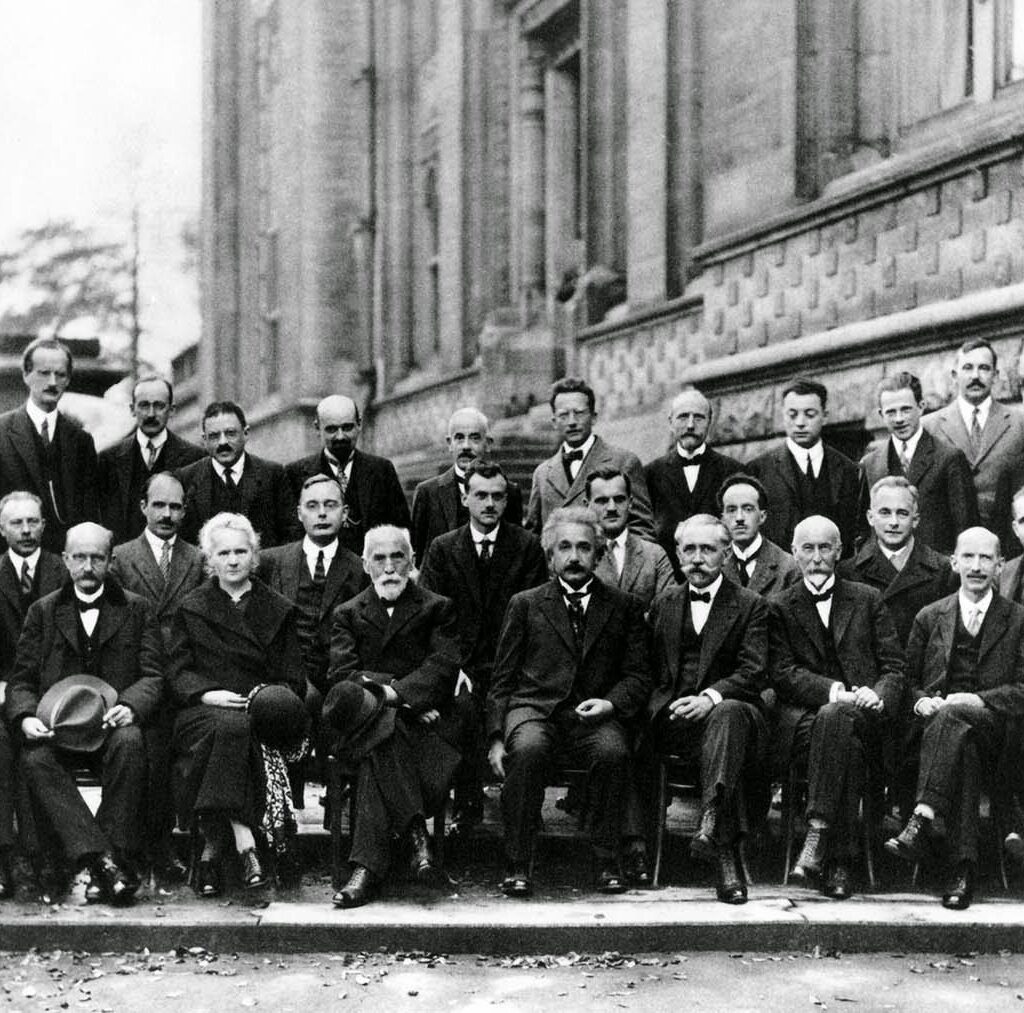
The famous group photograph from the conference has since become one of the most iconic images in scientific history. It featured giants such as Albert Einstein, Niels Bohr, Werner Heisenberg, Erwin Schrödinger, Max Planck, Marie Curie, and many others whose discoveries transformed our understanding of reality.
Background of the Solvay Conferences
The Solvay Conferences were initiated by Belgian industrialist and philanthropist Ernest Solvay in 1911. Their purpose was to bring together the brightest scientific thinkers to discuss unresolved problems in physics and chemistry.
By 1927, physics was undergoing a revolution. Classical Newtonian ideas that had dominated science for centuries were being challenged by strange new discoveries about atoms, light, and subatomic particles. Scientists were struggling to understand a world where particles behaved like waves and certainty seemed to disappear.
The fifth Solvay Conference, officially titled “Electrons and Photons”, became the arena where these revolutionary ideas were debated intensely.
The Rise of Quantum Mechanics
Before the conference, several breakthroughs had shaken the foundations of classical physics:
- Max Planck introduced the idea of energy quanta in 1900.
- Albert Einstein explained the photoelectric effect using light particles called photons.
- Louis de Broglie proposed that matter could behave like waves.
- Werner Heisenberg developed matrix mechanics.
- Erwin Schrödinger formulated wave mechanics.
One of the most important concepts discussed at the conference was the uncertainty principle:
This principle, introduced by Werner Heisenberg, stated that the exact position and momentum of a particle cannot both be known simultaneously with perfect precision. This idea challenged the deterministic worldview of classical science.
Einstein vs. Bohr: The Great Debate
The most dramatic aspect of the conference was the intellectual confrontation between Albert Einstein and Niels Bohr.
Bohr defended the new Copenhagen Interpretation of quantum mechanics. According to this view:
- Reality at the quantum level is fundamentally probabilistic.
- Physical properties do not exist in a definite state until measured.
- Observation plays a crucial role in determining outcomes.
Einstein strongly disagreed. He believed that the universe must obey deeper deterministic laws that quantum mechanics had not yet discovered. He famously criticized the probabilistic nature of quantum theory with the statement:
“God does not play dice with the universe.”
Bohr reportedly replied:
“Einstein, stop telling God what to do.”
During the conference, Einstein repeatedly proposed thought experiments attempting to expose contradictions in quantum mechanics. Each time, Bohr responded with detailed explanations defending the theory. Their debates became legendary and are still studied today in philosophy and physics courses around the world.
The Legendary Group Photograph
The 1927 conference is remembered not only for its debates but also for its remarkable participants. Of the 29 attendees, 17 either were or later became Nobel Prize winners.
The photograph symbolized a unique moment in history when the greatest scientific minds gathered in one room. Never before had so much intellectual power been concentrated in a single conference.
Among the attendees were:
- Paul Dirac
- Wolfgang Pauli
- Hendrik Lorentz
- Arthur Compton
- Max Born
The image has become a symbol of scientific brilliance and human curiosity.
Why the Conference Was Important
The Solvay Conference of 1927 marked a turning point in the history of science because it established quantum mechanics as the leading framework for understanding the microscopic world.
The discussions at the conference influenced generations of physicists and led to technologies that shape modern life today, including:
- Semiconductors
- Lasers
- Quantum computing
- MRI machines
- Modern electronics
The debates also raised profound philosophical questions:
- What is reality?
- Does observation affect existence?
- Is the universe fundamentally deterministic or probabilistic?
These questions remain relevant even today.
Legacy of the 1927 Solvay Conference
The conference demonstrated that scientific progress is driven not only by experiments and equations but also by debate, skepticism, and philosophical inquiry. The respectful but intense disagreements between Einstein and Bohr showed how competing ideas can deepen human understanding.
Today, the 1927 Solvay Conference stands as one of the greatest intellectual gatherings in history. It reminds us that science is not merely a collection of facts but an evolving journey to understand the deepest mysteries of the universe.
Nearly a century later, the questions raised in Brussels continue to inspire physicists, philosophers, and curious minds across the world.